Pininfarina – A Gentleman with an Eye for Beauty
Sergio Pininfarina – the Grand Master of Italian Design – died yesterday at the age of 85 after a long illness. Although his world-renowned company struggled in the last few years of his life, he was still considered as one of the most influential car designers in the world. Pininfarina was not just a fantastic designer who understood aesthetics like no other, but he was also interested in making it available to the masses. Today, I would like to focus on Sergio Pininfarina, his clothes as well as his Turin-based company, but first let’s start with the history. Here you can find a gallery of Pininfarina car designs.
Pininfarina History
Sergio’s father Battista Farina was born in 1893 as the 10th of 11 children. As the youngest brother, he always had the nickname Pinin, which means “baby”. On 22nd May 1930, he founded Carrozzeria Pinin Farina in Turin, which specialized in building individual car bodies or small, limited series for the rich and famous.
The first famous car designed by Pinin Farina was the Lancia Dilambda, which was introduced at the 1931 Concours d’Elegance at Villa d’Este. Other notable cars from this era included the Hispano Suiza Coupé and the Fiat 518 Ardita. However, the company’s biggest success under Battista’s leadership evolved in 1946, when they created the body of the coupé Cisitalia 202 GT . It was so revolutionary because it redefined what sports cars looked like at the time: the lines were smooth, everything was rounded and aerodynamic. Most importantly, it was designed in one piece. All the car parts, including the door handles, became part of one design. Until then, car parts had always been considered to be separate units. In total, only 170 cars were built and the aluminum parts were shaped by hand over wooden forms rather than on an assembly line. It won awards at every major car show and therefore, it comes as no surprise that it was admitted to the Museum of Modern Art (MoMA) in New York in 1951. In fact, it was one of only “Eight Automobiles” in the MoMA’s first car exhibition.
Pininfarina & Ferrari
The success of the Cisitalia was considered the big breakthrough, and in 1951, Enzo Ferrari invited Pinin Farina to Modena. Battista, equally as proud as his peer, suggested that they meet in Turin – Farina’s hometown - instead. These differences could have almost killed the collaboration before it began, but when Sergio suggested to meet at a restaurant in Tortona half way between Turin and Modena, the collaboration flourished.
Sergio was responsible for designing all Ferrari bodies but also for managing the relationship between the two companies. Many in the industry did not believe that this project would last long since both Enzo and Battista were like two Prima Donnas in the same opera. Nevertheless, Pininfarina is still designing for Ferrari.
Sergio Pininfarina & The Company
Sergio was born on 8th September1926, in Turin, Italy. He graduated with a degree in mechanical engineering from the Polytechnic University of Turin in 1950, and subsequently he began his career with the family company. Even before he joined officially, Sergio was deeply rooted in the business. For example, in 1946, Italy was barred from Paris Motor Show, the two set off from Turin for France driving two new cars, an Alfa Romeo 6C 2500 S and a Lancia Aprilia cabriolet. When they reached the Grand Palais in Paris, they parked the cars in front of the entrance to the show, stealing the limelight from the exhibits inside.
As previously mentioned before, Sergio got along well with Enzo Ferrari, and so he quickly became an important employee of Pinin Farina. In 1961 he became the Managing Director and upon his father’s death in 1966 he became the chairman. The same year Giovanni Gronchi – at the time Italy’s President – changed the family name per decree from Farina to Pininfarina, and the company’s name followed suit. For the next 40 years, Sergio was a strong leader who made every final decision on projects and the success of his cars proved his instincts to be spot on.
The first Ferrari body from Sergio was the Ferrari 212 in1951 and 250 GT in 1954. In 1955, he released the Alfa Romeo Giulietta Spider, which became very popular and marked the step to large scale body production for the firm (more than 27,000 bodies were manufactured). Just like his father, Sergio was interested in aesthetics and aerodynamics and with their success came many imitators. However, Sergio Pininfarina was aware of his talent and grateful for the honor; he believed that they only copied his designs because they were so good. Moreover, he wanted to make his designs accessible to the masses and so Pininfarina also collaborated with Peugot, Mistubishi, Fiat, Chevrolet, and Cadillac, some of which resulted in highly successful cars.
In 1965, Sergio designed his personal favorite, the Dino Berlinetta Speciale, which was named after Enzo Ferrari’s late son Alfred “Dino”. Although at the time it was thought to be an entry level car, the Dino was a mid-engine rear-drive sports car with a V6 (instead of a 12 cylinder engine)that was produced from 1968 – 1976; today it is a highly respected Ferrari. Apart from the Dino, he created the body of models such as 410 SA (1959), the Ferrari Testarossa (1984), the F40 (1987) and the Enzo (2002).
Sergio Pininfarina was never happy with the development of increasingly heavier, fuel based cars, and so he always kept an eye on the latest technology. Consequently, he also designed low emission cars and tried to create electric cars. Pininfarina also branched out in other areas of product design, and eventually the Pininfarina label could be found on trains, espresso machines and ski boots.
In 2005, Sergio was appointed as a Senator for life and a year later, he formally retired and passed on leadership to his son Andrea. Subsequently, the Pininfarina company slipped into financial turmoil and went deep in the red. Just as Andrea seemed to have reached a agreement with the company creditors, he died tragically in a motorcycle accident.
Subsequently, Andrea’s brother Paolo became chairman of the company, but he could not stop the decline. In 2009, Pininfarina was supposedly 600 million Euros in debt, but thanks to their strong brand name, they hope to return to profitability this year for the first time in years. In the meantime, they even suspended working on car bodies, shifting the focus on other design areas, though they continue to design for Ferrari.
Sergio Pininfarina’s Clothes
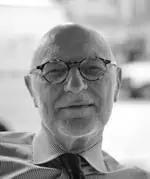
Since we always pay particular attention to clothing, we also wanted to take a look at Sergio Pininfarina suits and outfits. As an influential designer, one would expect that the clothes would match the man. Overall, he seems to have been a strong supporter of muted color ranging from dark gray to blue. In his early years, he would wear double breasted jackets on a regular basis and sometimes even a knit tie, while his shirts remained mostly light blue or white. Later he would stick with single breasted suits and occasionally add a vest.
Interestingly, the mid gray flannel chalk stripe suit seems to have been one of his favorite outfits throughout his life.
For awards ceremonies, he would sometimes don a tuxedo with simple black bow tie, white shirt, and a waistcoat. In one of the pictures, you can see that the shirt peeks out from underneath. While not overly tragic it is a good indicator that Pininfarina was never really particular about his dress; much rather, he simply wore the business uniform. Nevertheless, his creations reveal a true sense of artistic style.
Make sure to take a look at Pininfarina’s cars.
If our pictures inspire you, please feel free to share but always link back to the Gentleman's Gazette
2 Trackbacks
- Pininfarina Cars — Gentleman's Gazette - [...] Cars by Sven Raphael Schneider on July 5, 2012 in Cars, Savoir Vivre After I introduced you to Sergio ...
- Monday Grab Bag of Links … | The Pretense of Knowledge - [...] BMW R75/6 cafe racer Pininfarina – A Gentleman with an Eye for Beauty 2012 Tesla Model S Signature Performance ...


Ahmed Sajeel - July 5, 2012
What a beautiful article and homage to a man who understood and translated beauty better than the best. Thank you for this one !!!