In this article, which is part two of our examinations of overcoats, we will continue our explanation with the the Guards Coat. In case you missed the first part, read about the Ulster topcoat here. Part three is also available, and it covers the Paletot.
Table of Contents
Characteristics of the Guards Coat
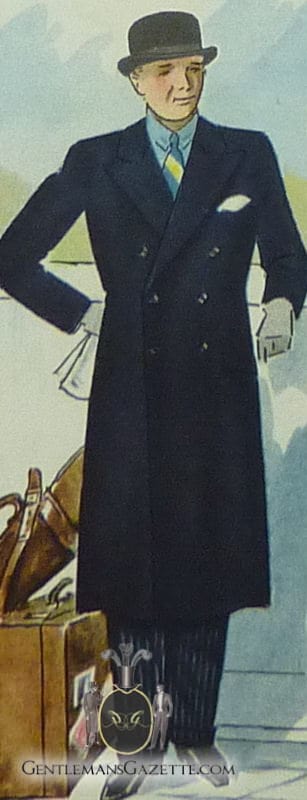
As the name Guards coat implies, this overcoat derives from the coat that English Officers of the Guard used to wear. Today, a Guards Coat generally has six characteristic elements:
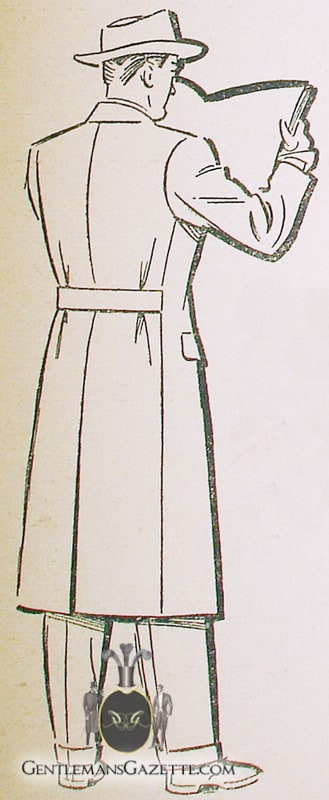
- Peaked lapels. Unlike the Ulster, the Guards coat has peaked lapels since it is more formal. It should be noted that one needn’t button up this overcoat all the way.
- 6×3 Buttons. Since the Guards coat does not need to be buttoned up all the way, it is perfectly adequate to have the top row of buttons placed further apart from each in order to achieve a more formal look. Also, the buttons are placed higher than on an Ulster.
- Welted pockets. Since the Guards coat is more formal than the Ulster, it has welted pockets instead of patch pockets
- No contrast stitching. For the same reason there is no contrast stitching.
- No cuffs. There are no cuffs on the sleeves of a Guards coat.
- Belted back. In general, a Guards coat is cut more closely to the body than an Ulster. Nevertheless, it has a belted back without buttons, since they would make the overcoat look less formal. Some Guards coats have an inverted pleat which allows the wearer to move more easily.
Differences Between the Guards Coat and the Ulster Coat
Unlike the informal Ulster, the Guards coat is an elegant coat which was originally designed for the city. It mostly comes in plain, dark colors such as deep navy or midnight blue. Nevertheless, due to its belted back, it is a garment that can be worn to more informal occasions as well.
Reader Comments
Comments are closed.