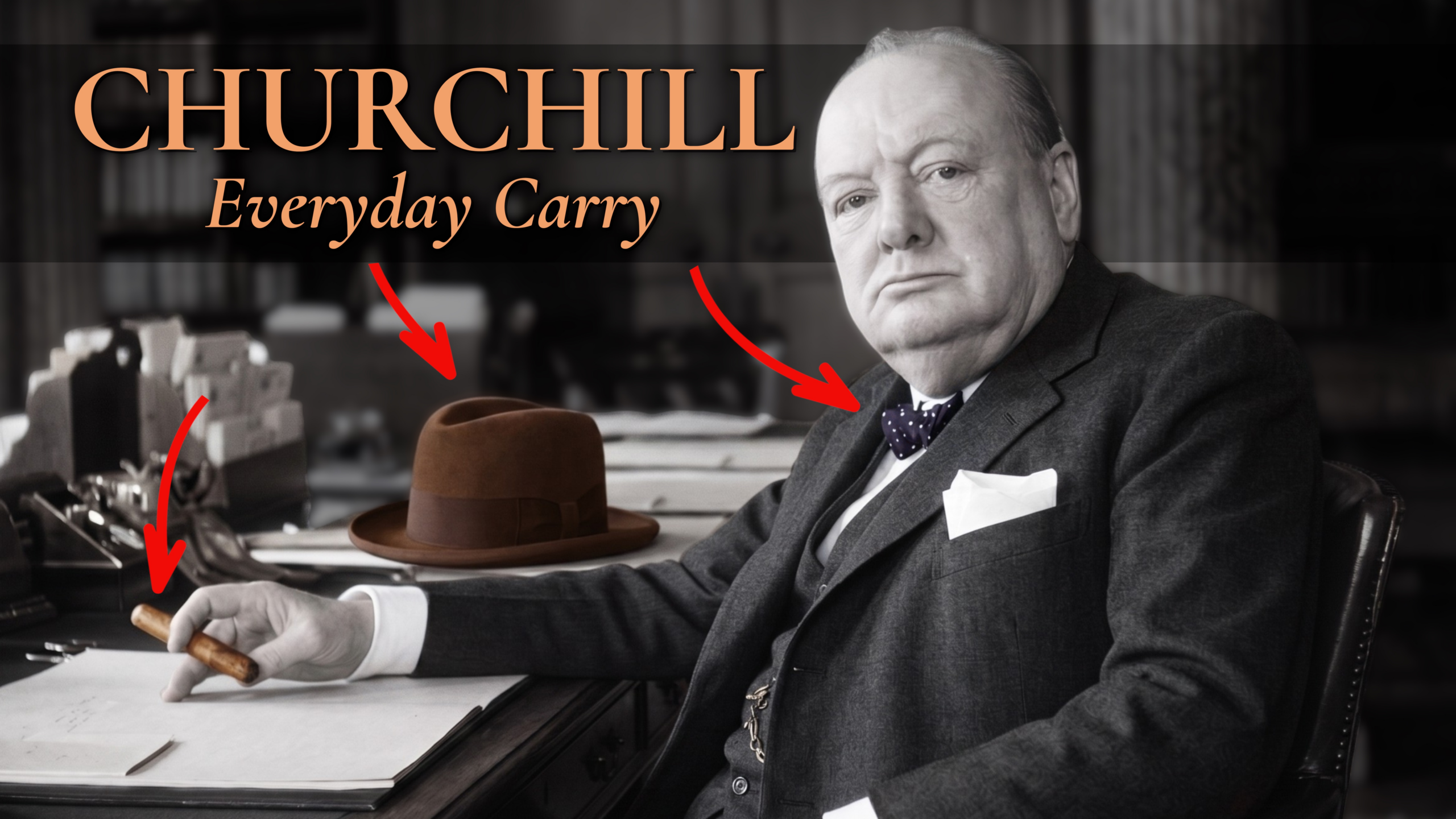
Winston Churchill is often remembered as a symbol: the bulldog jaw, the defiant speeches, the ever-present haze of cigar smoke. Yet like any man, he lived his life through a small, carefully chosen set of daily objects; tools that helped him think, decide, and project authority. In contemporary terms, they were his everyday carry: a personal “suit of armor” made of metal, silk, tortoiseshell, and velvet rather than steel.
What follows is a look at eight such items, and what they can teach the modern gentleman about heritage, quality, and the quiet power of ritual.

1. The Fingerprint of Heritage: The Signet Ring & The Pocket Watch
The Spencer-Churchill Signet Ring
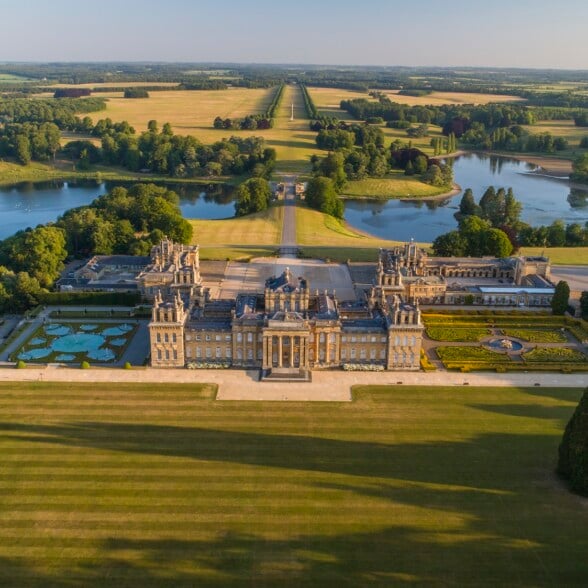
For Churchill, heritage was not an abstract concept; it was literally at his fingertips. His gold signet ring, likely made by Garrard, the royal jeweler, bore the Spencer-Churchill arms and linked him directly to the great dukes of Marlborough and to Blenheim Palace, his ancestral home and birthplace.
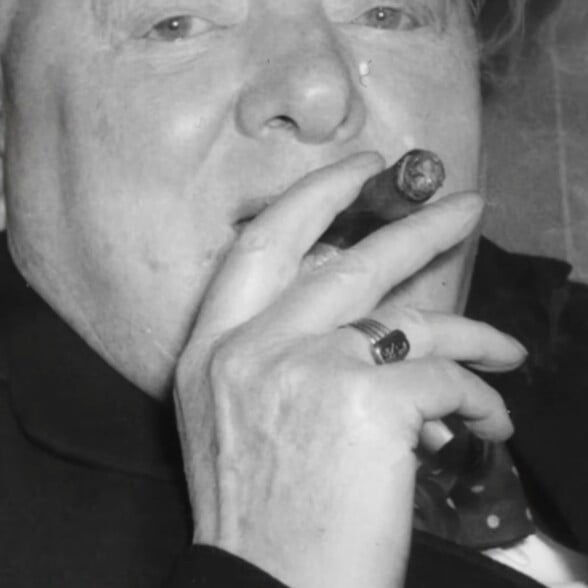
On which finger did Churchill wear his
Signet Ring?
You might expect a signet ring like this to be worn on the pinky finger, which was the more flamboyant style on the continent and a style often seen today, but Churchill chose to wear his on the ring finger of his right hand. It wasn’t meant to be a flashy piece of jewelry, but rather a constant and sober connection to his duty and his heritage, serving as a physical reminder of the weight of history on his shoulders.
Discover what rings mean on each finger
“The Turnip:” The Breguet Pocket Watch
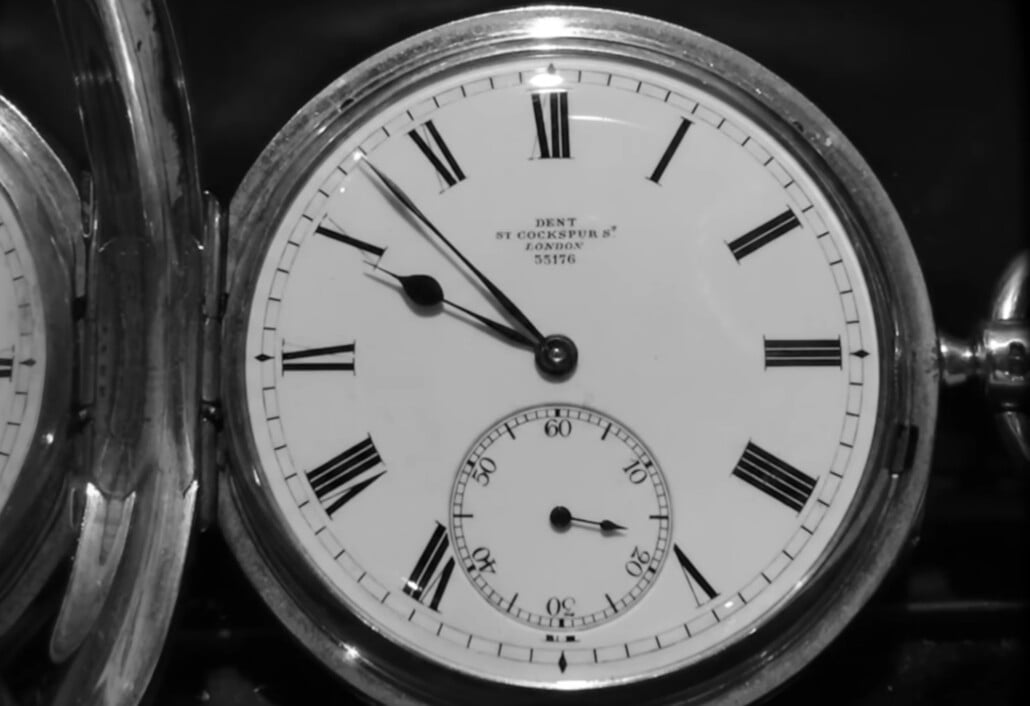
In an age when the wristwatch was becoming the standard for most, and for military men in particular, Churchill remained stubbornly loyal to the pocket watch.
His was a Breguet reference number 765 equipped with a minute-repeating complication, which he affectionately nicknamed “the Turnip,” likely because of its large and bulbous 18k gold case. It was a serious instrument for a serious man.
“Time is one thing that can never be retrieved. One may lose and regain friends. One may lose and regain money. Opportunity, once spurned, may come again, but the hours that are lost in idleness can never be brought back to be used in gainful pursuits.”
Winston Churchill
Why Churchill Continued to Favor the Pocket Watch
Why stick with a pocket watch while more portable and potentially more precise timepieces were coming about? For a gentleman of Churchill’s station in the early and mid-20th century, it was a mark of traditionalism and gravitas, whereas a wristwatch could be seen as a new-fangled gadget. A pocket watch required a deliberate ritual of reaching into the waistcoat to observe the time, which perfectly suited Churchill’s methodical nature.
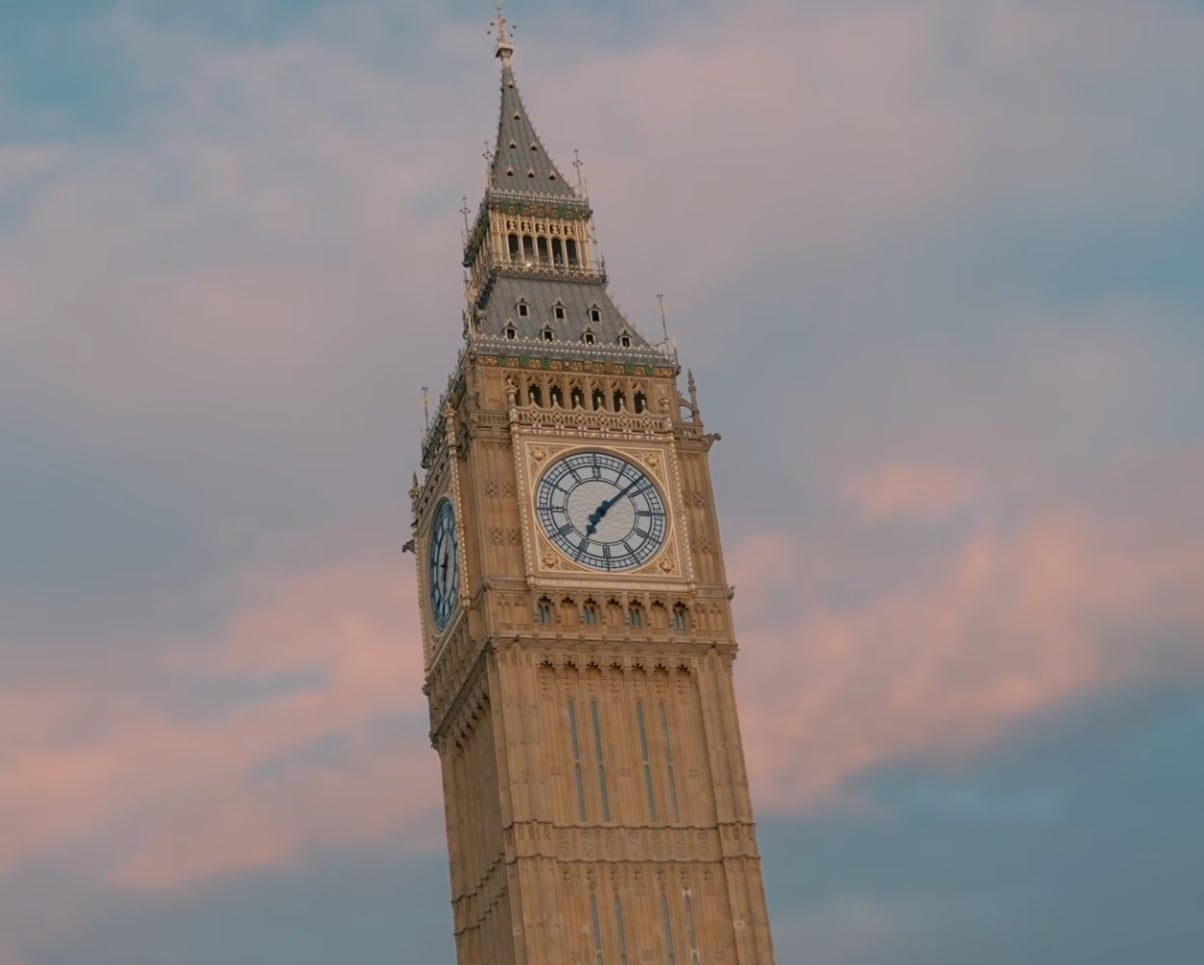
The Origins of Winston Churchill's Pocket Watch
“The Turnip” was originally commissioned in 1890 by John Spencer-Churchill, 7th Duke of Marlborough, from the esteemed London watchmaker Dent, who famously made the Great Clock at Westminster, known colloquially as Big Ben, even though Big Ben is technically the name of the bell. The Duke bequeathed the watch to Winston, and upon receiving it, he carried it with pride.
2. The Tools of Command: The Cigar & The Pen
The Cuban Signature: Romeo y Julieta Cigars
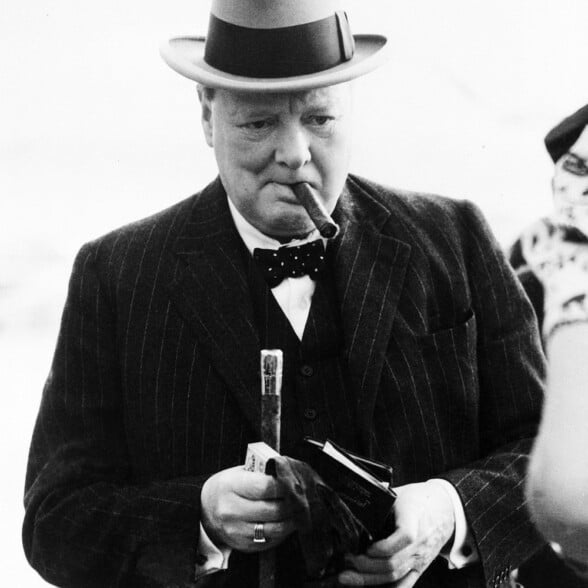
No accessory is more synonymous with Winston Churchill than his cigar, which served as his ultimate signature. More than a hobby, Churchill used cigars as a specific tool for his public image as both a hard-charging leader and a man who appreciated the finer things.
“Smoking cigars is like falling in love. First, you are attracted by its shape; you stay for its flavor, and you must always remember never, never to let the flame go out!”
Winston Churchill
His preferred brands were Cuban, specifically Romeo y Julieta, still in business today, and the now-defunct La Aroma de Cuba. Indeed, while Romeo y Julieta at one time marketed his preferred size of cigar as the Clemenceau (after the famed French Prime Minister), it became so associated with Churchill that the company later renamed the size after him, which remains the case today.
How Churchill Preferred His
Cigars
Churchill favored cigars that were long in size and mild in strength, and he reportedly went through eight to ten of them every single day, though not always through smoking; he would sometimes light up only to be pulled away by some other demand, and also had a habit of “consuming” cigars by chewing them down to nubs–to the extent that his wife, Clementine, sometimes made him wear a bib!
Learn how to enjoy your first cigar
The Fountain Pen
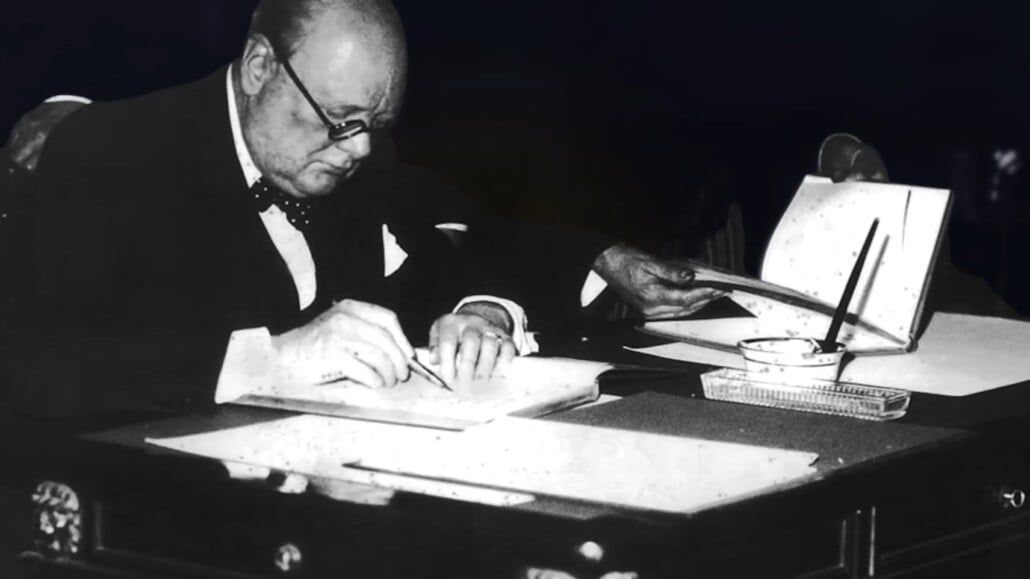
Although celebrated as a wartime prime minister, Winston Churchill understood that the pen was truly mightier than the sword.
In addition to his legendary speeches, Churchill was a prolific writer of books and memos, and he believed the tool for the job was just as important as the thought itself. Of course, he favored British-made pens from storied manufacturers; in his younger years he often used pens from Mabie Todd, particularly a model called the “Swan,” and later from Onoto and Conway Stewart.
Typically fitted with gold nibs, these were not disposable items by any means, but rather precise, weighted tools that felt significant in the hand.
Explore the five best inexpensive fountain pens for beginners.
3. The Silhouette of Authority: The Homburg & The Bow Tie
The Homburg Hat
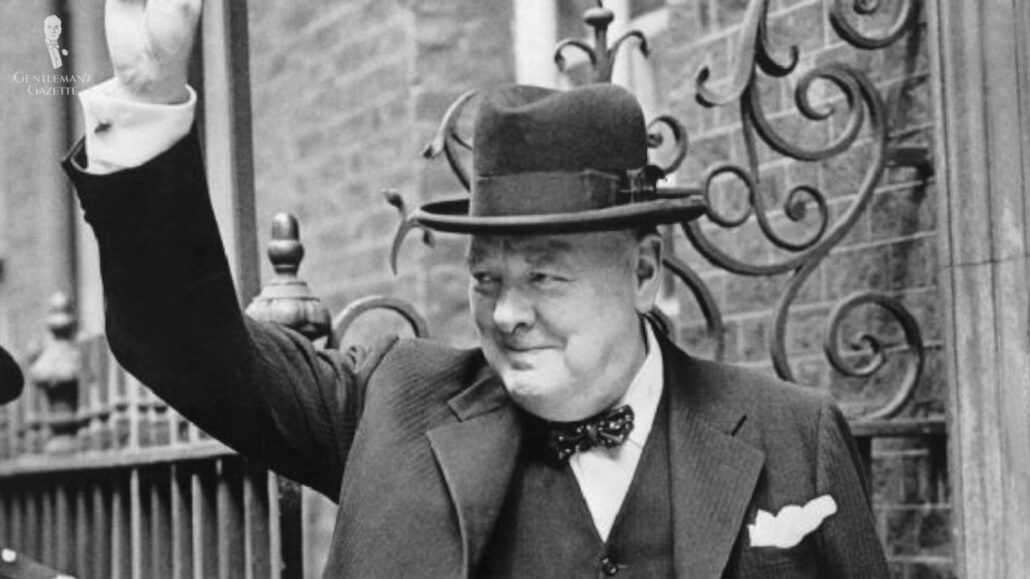
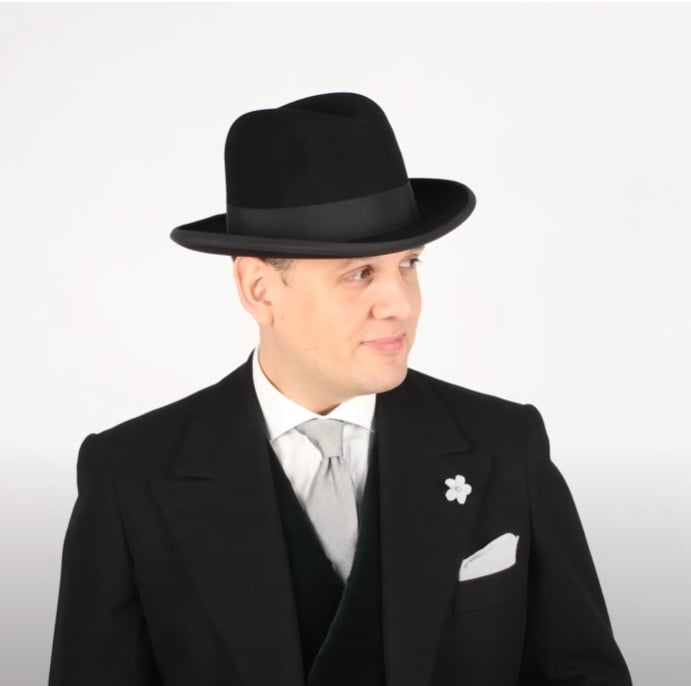
While many American gentlemen during this era might reach for a fedora, and formal occasions still demanded a top hat, Churchill had a distinct preference for the homburg. Featuring a rigid, rolled brim and a single lengthwise crease in the crown, this hat style originated in Germany, in the town of Bad Homburg, near Frankfurt.
Even so, it was two British figures who would influence the hat’s global popularity: first, Edward VII, who took to wearing it after vacationing in Bad Homburg in the 1880s-90s, and then Churchill, whose near-constant wearing of the homburg helped to turn it into a global symbol of British statesmanship.
The Fedora versus the Homburg
Why did Winston Churchill favor the Homburg over the Fedora? Likely because he was conscious of how each would impact his silhouette. Whereas the fedora has a pinched front and a more casual, pliable feel, the homburg is stiff, structured, and authoritative. It doesn’t slouch or lose its shape, and it commands respect the moment you see it, providing the perfect middle ground by being serious and dignified without the overt pomp of a top hat.
Learn more about the homburg
The Navy Spotted Bow Tie
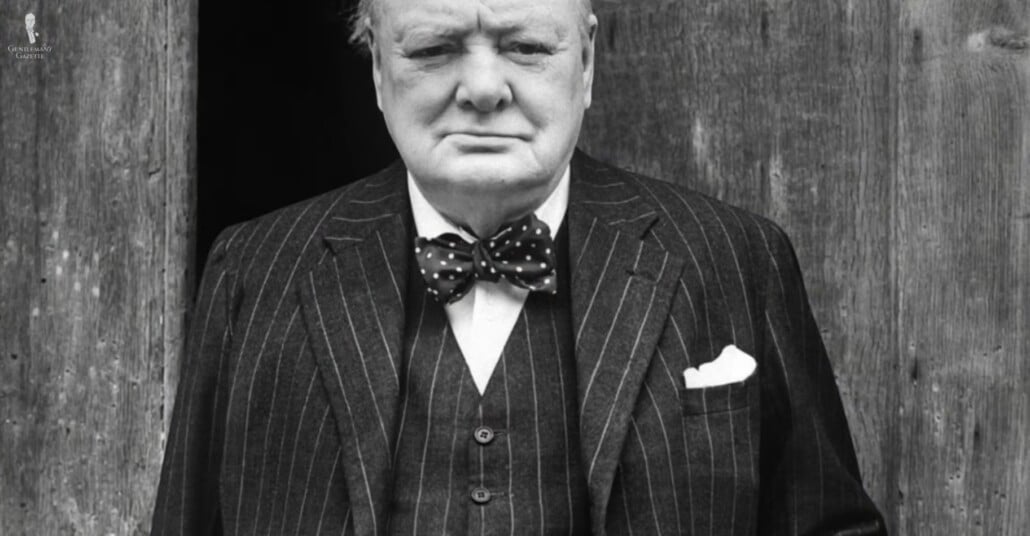
No sartorial accessory is as uniquely associated with Winston Churchill as his spotted bow tie. It was almost always the same pattern: navy blue with white polka dots.
This was a conscious, strategic choice on his part; standing in Parliament, getting snapped by flashbulbs for newspaper photos, or being filmed for newsreels, the sharp color contrast and memorable pattern made him instantly identifiable to the public. In a sea of somber suits and plain ties, the bow tie acted as a point of focus and a flourish of personality that told the world he had arrived.
Did you know?
The Blenheim Bow Tie
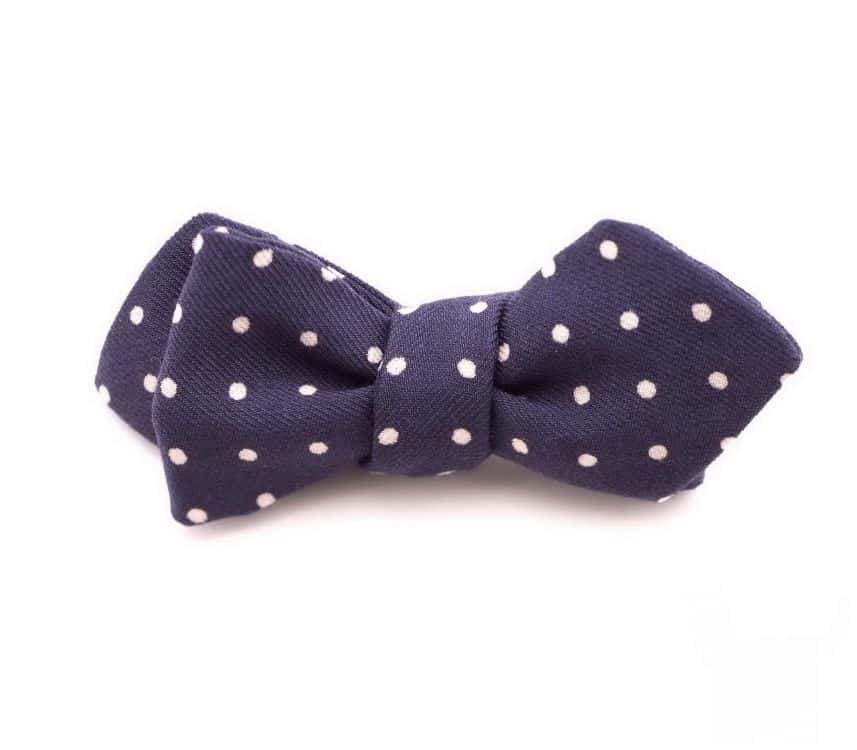
The navy with white dots bow tie became so identified with Churchill that haberdashers of the time would occasionally market it as the “Blenheim,” in a nod to the ancestral Churchill estate
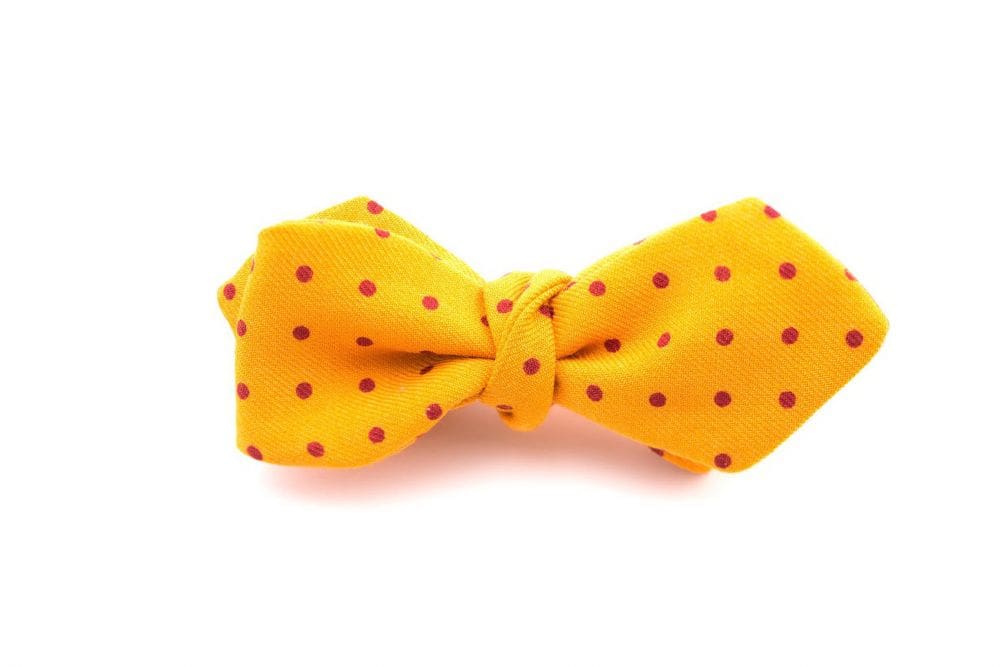
Get Your Own Blenheim-Style Bow Tie
Crafted from 100% Wool Challis Fabric Made in England in a Variety of Colors
Fort Belvedere
Navy & White Polka Dot
Fort Belvedere
Yellow & Red Polka Dots
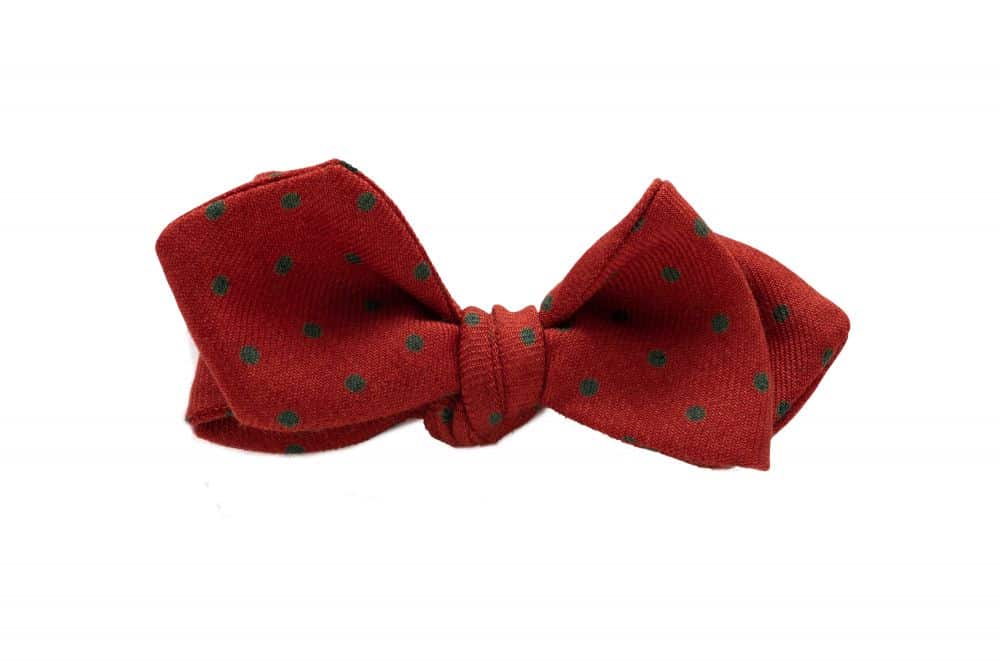
Fort Belvedere
Orange & Green Polka Dots
4. The Private Quarters: The Spectacles & The Slippers
Specialized Tortoiseshell Spectacles
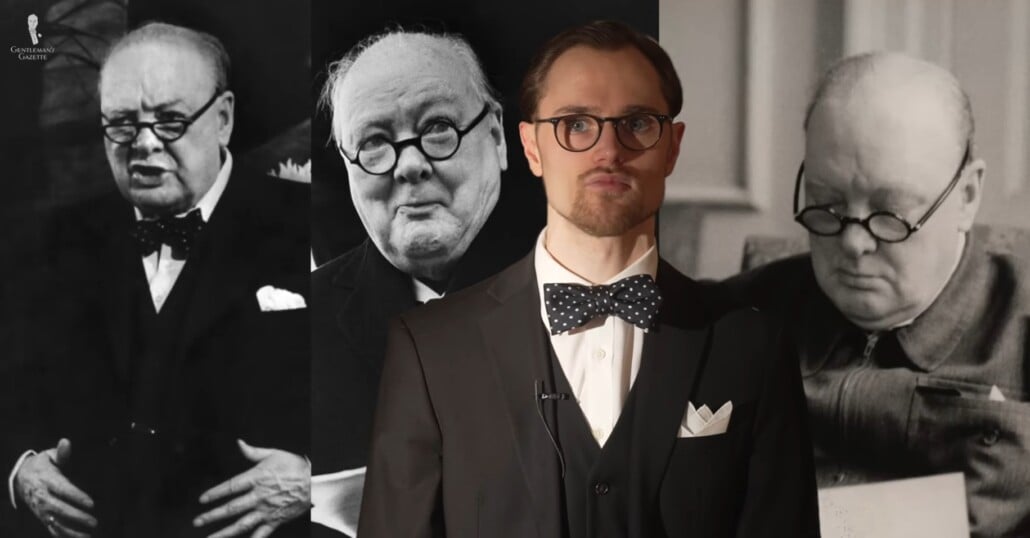
Because Churchill suffered from poor eyesight which worsened further as he aged, eyeglasses were a strict necessity for him. However, he didn’t settle for just one pair to handle every situation. He commissioned specific tortoiseshell frames, primarily from the firm of C.W. Dixey & Son, to suit his various daily tasks.
While these were functional tools, he ensured the frames maintained a dignified, old-world style that suited his face well. He treated his eyewear with the same level of consideration as any other element of his dress, because he knew it was a frequent component of his appearance.
Learn how to find the right eyeglasses for your face
Monogrammed Albert Slippers
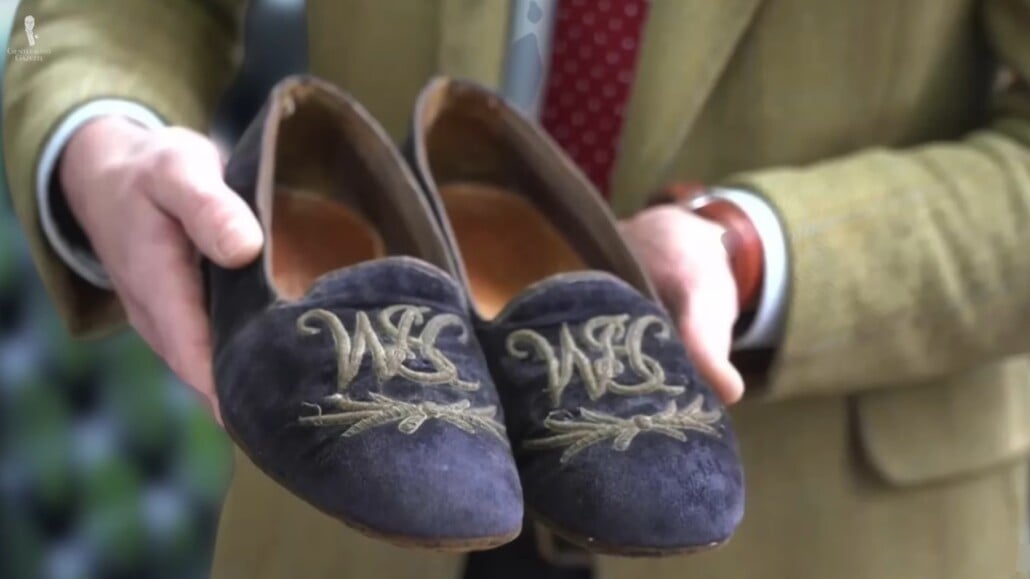
After a long day of managing global crises, Churchill would retire to his country home of Chartwell and change into comfortable house shoes. His favorite pair? Albert slippers.
What Are Albert Slippers?
This style of house shoe is traditionally made with black velvet uppers and a stiffer sole than other slipper styles, making it more similar to a dress shoe. They can feature the same grosgrain silk ribbon as the closely related opera pump, but more often the vamp is either plain or features motifs made with embroidery. The slipper is named in honor of Prince Albert, husband and consort of Queen Victoria, who helped to popularize this style in the mid to late 19th century.
Churchill tended to favor fairly conventional Albert slippers; his first known pair was a gift from a friend of his, the Lady Diana Cooper in black velvet with a monogram embroidered in gold.
He came to like the style so much that he had subsequent pairs made, generally in deep blue or maroon velvet, and embroidered with his initials in either gold or white. Photographs of the time show that not only did he wear his Albert slippers at home, but even ventured out in public on occasion while wearing them!
See what the Gentleman’s Gazette team wears at home
Implementation & Payoff
What You Can Learn from Winston Churchill’s EDC

- Surround yourself with items that serve a purpose, whether it be practical, psychological, or both.
- Favor items that you’ll use regularly, and opt for quality over quantity whenever possible.
- Items imbued with heritage and personal meaning will ground you in a firm sense of self as you navigate the world.
- When you build your own daily kit with intention, you are essentially building your own suit of armor. Thusly protected, there is nothing you can’t accomplish.
Which of Churchill’s EDC items do you find most interesting, and would you consider adopting some of them yourself? Let us know in the comments below. And if you’ve enjoyed this historical deep dive into an icon’s personal kit, give us some suggestions of other such figures for future installments!
Frequently Asked Questions
What was the specific brand and model of Churchill’s pocket watch?
Churchill carried a Breguet reference number 765, which he nicknamed “the Turnip” due to its large, bulbous 18k gold case. It featured a complex minute-repeating complication that allowed him to chime the exact time in the dark—a vital tool during the Blitz.
Why did Winston Churchill always wear a polka-dot bow tie?
His choice of a navy blue bow tie with white polka dots was a strategic branding move. The sharp contrast made him instantly recognizable in black-and-white newspaper photos and newsreels. It became so iconic that the pattern is still referred to by haberdashers as the “Blenheim” print.
Did Churchill actually smoke every cigar he carried?
While he was famous for having a cigar almost constantly, he didn’t always smoke them. He reportedly went through eight to ten cigars a day, but he often chewed them into nubs or let them go out while working. To keep his fingers clean while writing, he used a DIY paper wrap he called a “bellybando.”
What was unique about the way Churchill wore his signet ring?
Unlike many who wear signet rings on the pinky finger (the Continental style), Churchill wore his on the ring finger of his right hand. The ring bore the Spencer-Churchill family crest and served as a constant physical reminder of his ancestral heritage.
What was the purpose of the “dots” on Churchill’s spectacles?
Churchill had specialized tortoiseshell frames for different tasks. To tell them apart quickly, he had the temple tips marked with dots: one dot denoted his reading glasses, while two dots identified the pair used for speechwriting.
What are “Albert Slippers” and did Churchill really wear them in public?
Albert slippers are velvet house shoes with a quilted lining and leather sole, named after Prince Albert. Churchill’s pairs were typically navy or maroon velvet with his initials embroidered in gold. While designed for the home, he was occasionally photographed wearing them during public appearances.
What kind of fountain pen did Churchill use to write his speeches?
He was a loyal supporter of British craftsmanship, favoring pens from Mabie Todd (the “Swan”), Onoto, and Conway Stewart. He specifically preferred the Onoto plunger-filler for its large ink capacity, which allowed him to write lengthy manuscripts without interruption.
What to Watch Next
EDC 2026
Team GG’s Everyday Carry
1 Edwardian Essentials
1900s Gentleman’s EDC

15+ Years of Travel
Frequent Flyer Premium Travel Kit & EDC
Well now – to begin with the cigars: you describe cigar smoking as a “vice”. Pish, I say, and fie. Though Churchill would have put it better; and I’m just about to order a box; not, sadly, Romeo Y Julieta: the price of these now is prohibitive. I shall probably choose Nicaraguan or Honduran. And shall smoke them in open defiance of your characterization of them as a vice. The pocket watch Churchill owned can still be had, though again, at a vast price. The chain – I defy you to find a paper-clip chain of the length he must have worn today; his was gold, to match the turnip. I’m on the lookout for something similar, but plated.
You mention the Homburg – he also wore bowlers – but not the Stresemann suit, aka the gentleman’s lounge suit; I’d like to see that make a comeback – it’s practical, comfortable when well-cut, formal without being the full ticket, with tails…. I have one: at least I can afford that, and my Homburg. The Churchill uniform wasn’t unvarying, but if he’d had access to your range of bow-ties, I doubt he’d have stopped at the dark blue polka dot; he might have found it hard to resist a bigger splash of colour and fabric. And of course, he wore proper trousers: he might not have had much of a waist, but such as it was that was where the trousers sat: saw a picture of J D Vance the other, his appalling dress sense indicated by the trousers sitting on his hips … o tempora; o mores…
For me, a waistcoat, tie and watch are what has become my “signature”. I love waistcoats and have several that I wear, either English or Irish manufacture. My ties are English made and I am very partial to the navy blue with white polka dots, though not a bow tie, and a deep green with white polka dots. I do wear a wrist watch most of the time, either the Bulvoa’s (which can be my late Grandfather’s 1961, my Father’s Accutron 1966, or the Precisionist Chronograph that my wife bought me in 2015) or my Seiko dive watch, during my very casual moments, which is from my time in military service. I also wear and use my Great-Great Grandfather’s 1900 Elgin steel case pocket watch when I wear a waistcoat. The chain is a silver Albert chain that my wife bought me.
A very interesting article, though I’d like to see a description of the fragrances Churchill used. He loved taking baths and, for this purpose, bought Stephanotis bath salts; as for his eau de toilette, he used Special No. 127. It is also said that he used fragrances by Creed, and both Floris and Creed claim that Churchill’s signature scent came from their workshops.